

Rechargeable Disposable Vape: A Complete Guide for 2026
A rechargeable disposable vape is a prefilled, single-use e-cigarette with a USB-rechargeable battery, so it can run longer, but its e-liquid and coil still run out and the complete device eventually becomes waste. In measured pod-style disposables, power output ranged from 5 to 9 W, showing why charging extends battery life but doesn't turn the device into a reusable system (peer-reviewed analysis).
You're halfway through a session when the vapor fades, yet you can still see liquid inside. With a conventional disposable, that often means throwing away a partially used device. A rechargeable model can solve the dead-battery part of that problem, but only if you understand what charging restores, what it can't restore, and how the format differs from a refillable pod system.
This guide is for U.S. adults age 21 and older comparing convenience, specifications, waste, and battery handling. Product details can change, so verify the exact model instructions and current information on the relevant Pink Smoke Shop product pages before buying.
Table of Contents
- When Your Disposable Vape Dies Too Early
- What a Rechargeable Disposable Vape Actually Is
- Comparing Disposable Device Formats
- Understanding Puff Counts, Battery Specs, and Nicotine Strengths
- Pros and Cons of Rechargeable Disposable Vapes
- Safe Charging, Usage, and Disposal Guidance
When Your Disposable Vape Dies Too Early
A customer once brought in a disposable that had stopped producing vapor during the day. The device still felt substantial, and a quick look suggested there was liquid left, but the battery had reached the end of its charge. With a non-rechargeable model, the practical answer was replacement. With a rechargeable disposable vape, the same symptom may just mean the built-in battery needs to be connected to its factory charging port.
That distinction is useful, but it doesn't make every failure a charging problem. A blinking light can indicate low power, an airflow issue, a protection signal, or another fault, depending on the model. The safest approach is to identify the exact device and follow its instructions rather than trying a generic reset sequence. Pink Smoke Shop's guide to why a disposable vape light may be blinking can help you separate a battery symptom from other common causes.
What charging fixes and what it doesn't
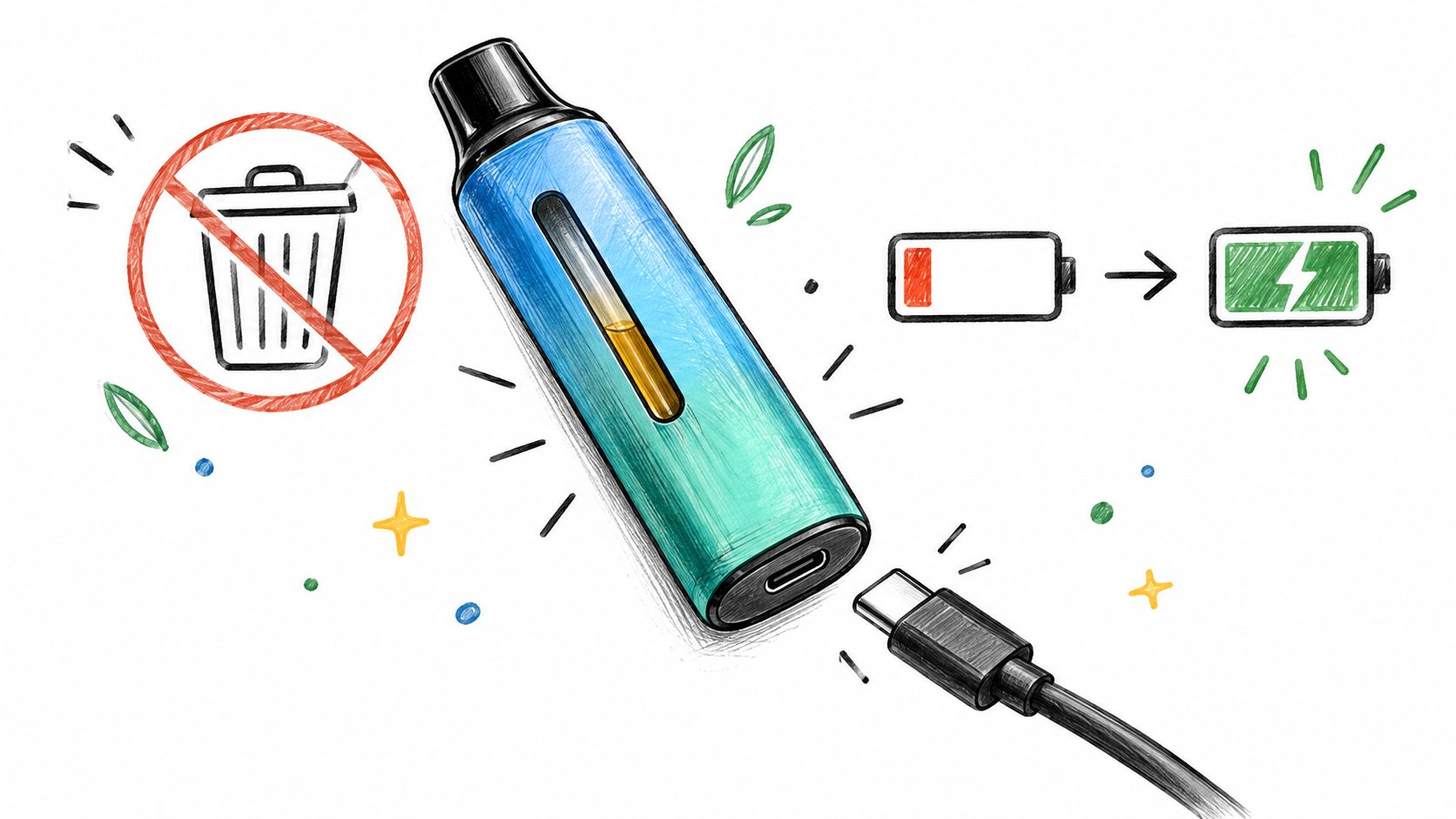
Charging can restore battery power on an undamaged device designed to accept a charge. It won't replenish depleted e-liquid, repair a failed coil, clear every airflow restriction, or make a sealed device refillable. If the device has a persistent burnt taste, produces no vapor after appropriate troubleshooting, or shows physical damage, repeated charging isn't a sensible repair strategy.
Rechargeable disposables became commercially important as disposable formats expanded. CDC Foundation monitoring recorded disposable e-cigarette unit sales rising from 4.1 million units on February 2, 2020, to 12.7 million by December 31, 2023, a 212.4% increase. Their share of measured U.S. e-cigarette unit sales rose from 26.2% to 57.2% during that period (CDC Foundation sales brief). Those figures describe sales, not safety or authorization, but they explain why shoppers now encounter more devices built around extended battery use.
Practical rule: If a device has liquid left but no battery power, recharge only when the manufacturer designed it for charging. If the device is damaged, unusually hot, swollen, leaking, or behaving abnormally, stop using it instead of trying to revive it.
What a Rechargeable Disposable Vape Actually Is
Think of the category as a disposable camera with a battery pack you can recharge. The camera still has a fixed roll of film, and the vape still has a fixed supply of e-liquid. Recharging removes one early limit, the exhausted battery, but it doesn't change the product's basic construction.
A rechargeable disposable vape normally combines a prefilled liquid reservoir, an integrated coil, a small lithium-ion cell, airflow hardware, and a charging port. The manufacturer seals the liquid section, so the customer uses the device until the liquid, coil, or internal hardware reaches the end of its intended life. The USB port extends runtime; it doesn't create a refill opening.
Rechargeable isn't the same as reusable
The easiest way to classify a device is to inspect what can be replaced. A charging port only accepts power. A refill port accepts e-liquid, and a replaceable pod lets you exchange the liquid-and-coil section while keeping the battery device.
A rechargeable disposable therefore sits between two familiar formats. It offers more battery convenience than a single-charge disposable, while avoiding the filling, cleaning, and pod changes associated with a reusable system. That simplicity is its appeal, but it also limits its lifespan and customization.
| Check | Rechargeable disposable vape | Rechargeable refillable system |
|---|---|---|
| Battery | Built-in rechargeable cell | Rechargeable battery device |
| E-liquid | Prefilled and not intended for replenishment | Refillable pod or tank |
| Coil | Integrated and generally not user-replaceable | Replaceable pod or coil, depending on design |
| Charging | Extends use of the existing liquid supply | Supports continued use with new liquid or pods |
| Maintenance | Low routine maintenance | More handling and upkeep |
| End of life | Whole device becomes waste when its sealed components are finished | Battery device may continue with replacement consumables |
The plain-language test
Look for three separate features: a charging port, a refill port, and a replaceable pod. A device with only the first is rechargeable but still disposable. Charging can't restore liquid that has been used, and opening the casing to add liquid or reach the cell creates risks the product wasn't designed to manage.
Comparing Disposable Device Formats
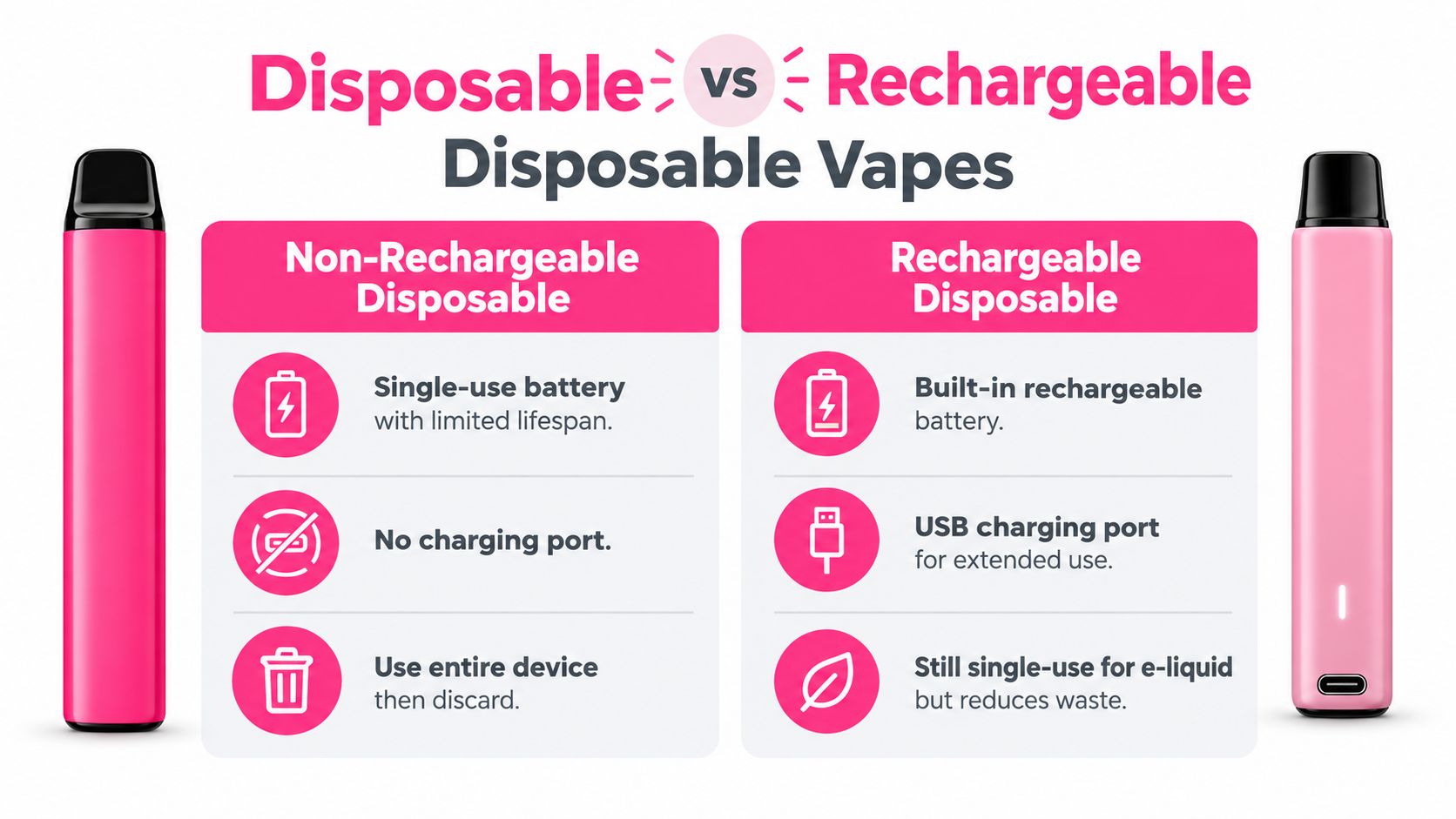
The right format depends less on marketing language than on your daily habits. Someone who wants a sealed device with minimal upkeep may prefer a rechargeable disposable. Someone who wants to keep one battery device and change flavors or coils may be better served by a rechargeable refillable system. A non-rechargeable disposable is the simplest option, but the battery can't be restored once it is depleted.
| Feature | Non-Rechargeable Disposable | Rechargeable Disposable | Rechargeable Refillable System |
|---|---|---|---|
| Battery management | No charging; use ends when the built-in battery is depleted | Charge the built-in battery through the specified port | Recharge the battery device |
| E-liquid | Prefilled and sealed | Prefilled and sealed | Add compatible e-liquid through a refillable pod or tank |
| Coil replacement | Not intended | Not intended | Often possible through a pod or coil replacement |
| Convenience | Highest initial simplicity | Simple, with charging added | Requires more setup and maintenance |
| Customization | Limited to the selected product | Limited to the selected product | More control over liquid and compatible components |
| Waste profile | Whole device discarded after use | Whole device still discarded after liquid or coil depletion | Consumables are replaced while the battery device may remain in use |
| Best fit | Short, simple use with no charging | Users who want sealed convenience without a battery ending use early | Users willing to maintain a system for ongoing use |
Choose around maintenance tolerance
Rechargeable disposables work well for adults who value a prefilled setup and don't want to carry liquid bottles, spare pods, or cleaning supplies. They can also be practical when a dead battery would otherwise leave usable liquid behind. The trade-off is that convenience comes with less control over coil life, airflow, and flavor changes.
Refillable systems demand more attention, but they separate the battery from the consumable section. That makes them a more reusable arrangement, although the pods, coils, and e-liquid still require replacement. Pink Smoke Shop's guide to the difference between disposable vape kits and replacement pods is useful when those two formats look similar on a product page.
A rechargeable label shouldn't decide the purchase by itself. Ask whether you want to recharge a sealed device for longer use, or whether you want a battery platform that can accept new pods after the original liquid is gone.
Understanding Puff Counts, Battery Specs, and Nicotine Strengths
A customer sees 15,000 puffs, a USB charging port, and a nicotine number on the box, then assumes all three figures describe the same kind of longevity. They do not. Puff count is a usage estimate, battery specs describe how long the device can power its coil, and nicotine strength refers to the liquid inside. Put together, they help you compare products. Read alone, any one of them can be misleading.
That distinction matters even more with a rechargeable disposable. Charging can extend battery availability. It does not refresh the e-liquid, replace the coil, or turn the device into a reusable pod system.
Earlier research on pod-style disposable e-cigarettes reported measured differences in output, voltage, nicotine concentration, and nicotine yield across tested products. In practice, that matches what many adult users notice. Two devices with similar puff claims can feel quite different over time, especially as battery level drops, airflow varies, or the coil ages inside a sealed body.
Read specifications as estimates
Real use is rarely neat. Longer draws, repeated chain use, airflow design, coil resistance, liquid thickness, and battery charge level all change how a device performs from one session to the next. A high puff claim should be treated as a test-condition estimate, not as a standardized dose and not as a promise that every draw will feel the same from start to finish.
The safer habit is simple. Check the exact model in front of you, then verify the details on its packaging or product page instead of relying on a copied marketplace title or a broad brand claim.
| Specification | What It Means | What to Verify |
|---|---|---|
| Puff estimate | A projected number of draws under testing conditions | Whether the manufacturer labels it as an estimate and how the device is tested |
| Battery information | The power source available to the integrated coil | Charging port, charging method, indicator behavior, and manufacturer instructions |
| Nicotine strength | The concentration listed for the specific liquid | Exact strength, whether the product contains nicotine, and the current product details |
| Coil and airflow | Hardware that shapes draw resistance and aerosol production | Whether the coil is integrated, the airflow is adjustable, and what maintenance is allowed |
| Device identity | The exact model rather than a broad brand family | Packaging, authenticity information, and applicable regulatory status |
Battery specs matter most if the battery would die before the sealed liquid is fully used up. That is the main advantage of the rechargeable format. It helps you access the liquid already in the device for longer, assuming the coil is still working acceptably. Once the liquid is empty or the integrated coil drops off, charging has nothing useful left to preserve.
For end-of-life handling, this guide on recycling cells with DigiDevice gives practical context on lithium cells and recycling considerations.
Pros and Cons of Rechargeable Disposable Vapes
The strongest argument for this format is practical rather than technical. A rechargeable disposable can prevent a dead battery from ending the session while liquid remains, without requiring the user to fill a pod or replace a coil. For adults who prioritize sealed convenience, that may be a reasonable compromise.
The limitation is just as important. Once the liquid is gone or the integrated coil degrades, charging no longer adds useful life. The device still contains a battery and mixed materials, so rechargeable doesn't mean fully reusable, automatically recyclable, or waste-free.
| Advantages | Disadvantages |
|---|---|
| Longer battery availability: Charging can keep an undamaged device operating after its first battery charge is depleted. | Sealed liquid supply: You can't restore e-liquid after the reservoir is empty. |
| Less maintenance: The device avoids routine filling and coil changes. | Limited customization: Airflow, coil, and liquid choices depend on the model. |
| Fewer partially used devices: Recharging may reduce disposal caused only by a depleted battery. | Whole-device end of life: The integrated battery, reservoir, coil, and casing remain together after use. |
| Simple travel routine: Carrying one prefilled device can be easier than carrying a refillable setup and liquid. | Battery handling matters: Repeated charging introduces electrical and thermal failure modes. |
| Straightforward buying decision: Select the exact liquid strength and device features listed for that product. | Puff estimates vary: Advertised capacity doesn't promise identical runtime for every user. |
Match the trade-off to your routine
Choose a rechargeable disposable if you want prefilled simplicity, accept a sealed liquid supply, and mainly need the battery to last through that supply. Choose a refillable system if you want to change liquids, replace pods, or keep using the same battery platform over time. Choose a non-rechargeable disposable only if the absence of charging is more important to you than extending the device's battery life.
Environmental claims deserve the same scrutiny as performance claims. Recharging may reduce the number of devices discarded because their batteries die early, but it doesn't eliminate waste once the liquid or coil is exhausted. The FDA's battery guidance advises users to avoid damaging, opening, or modifying vape batteries (FDA battery safety guidance).
Safe Charging, Usage, and Disposal Guidance
A rechargeable disposable often looks simple. In practice, the safest habit is to treat it like a sealed, battery-powered product with one job. Charging can help you finish the prefilled liquid that is already inside, but it does not turn the device into a reusable system with replaceable parts.
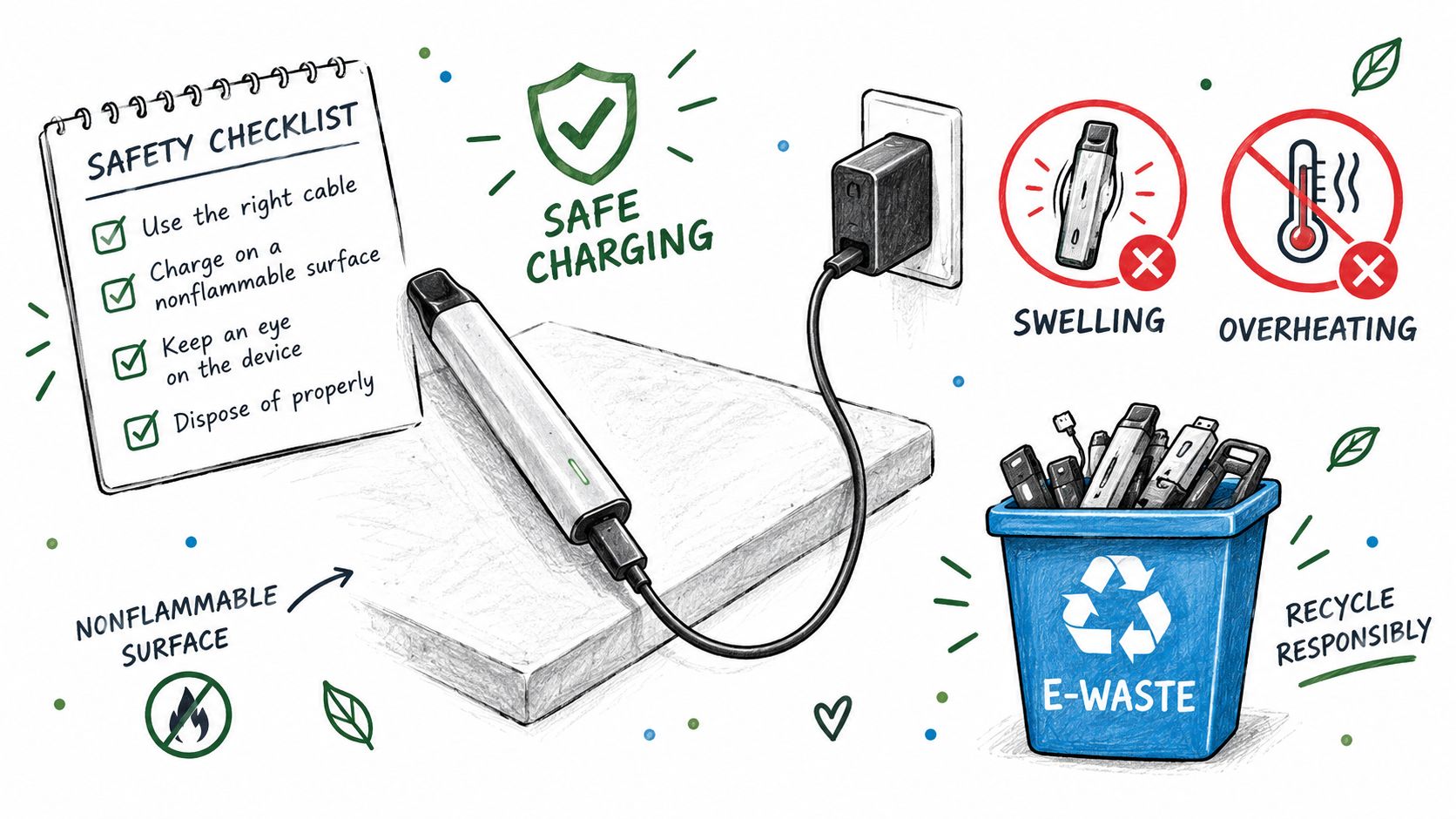
Start with the hardware. Confirm the device has a charging port, then inspect the body and connector before you plug anything in. Charge on a clear, nonflammable surface, use the cable and power source specified for that model, and stay nearby while it charges. If the casing is cracked, swollen, leaking, wet, unusually hot, or giving off an abnormal smell, stop there.
Small lithium-ion cells are sensitive to heat, impact, and electrical abuse. In a technical battery study, cells recovered from disposable e-cigarettes completed 474 charge-discharge cycles at a 1C rate before reaching 80% capacity retention, and nail penetration produced a maximum temperature of 495°C. Those results do not make home testing acceptable. They show why opening the casing, puncturing the cell, or trying to replace the battery is a bad idea.
Use a conservative handling routine
- Inspect first: Stop using the device if it swells, leaks, becomes unusually hot, smells abnormal, or shows charging damage.
- Charge while attended: Keep it on a clear, nonflammable surface and disconnect it when the manufacturer's completion signal indicates charging is done.
- Avoid improvisation: Never strip cables, bypass protection circuits, open the casing, puncture the cell, or attempt to replace the internal battery.
- Protect the port: Keep the device away from water, heat, loose metal objects, and anything that could damage the connector.
- Dispose responsibly: A finished rechargeable disposable is battery-containing electronic waste. Do not put it in household trash or curbside recycling. Local acceptance rules vary, so confirm them before drop-off. A practical reference for finding IT asset battery recycling can help identify disposal options.
Age restrictions and product authorization are separate from charging. The FDA's FDA Tobacco 21 requirements apply to electronic nicotine delivery systems, and the agency's marketing order framework addresses whether a specific tobacco product may be legally marketed.
Before buying, check the exact model's current specifications and instructions. A product guide such as RAZ Blueberry Watermelon can help you confirm the listed features for that device, but availability and specs can change.