

Vapes with Pods: Complete Guide for 2026
You're standing in front of a wall of devices, and they all look close enough to be the same. One box says disposable, another says pod kit, and a third promises more control than you probably wanted when you just needed a straightforward vape. Vapes with pods sit right in the middle of that confusion, which is exactly why they deserve a plain-English guide.
The useful part is simple, once you sort the pieces out. A pod vape is a device that uses a removable pod, usually with liquid already inside or with a cartridge you refill yourself, and the device supplies the power that turns that liquid into aerosol. That basic setup is different from a disposable, where the battery and liquid are meant to be used up together, and different again from a larger mod that expects you to know more about settings and upkeep.
Table of Contents
- What Makes Pod Vapes Different from Other Vapes
- Closed Pods and Refillable Pods Explained
- How Pod Vape Systems Work
- Pod Vapes vs Disposable Vapes and Mods
- Pod Compatibility, Specs, and What Actually Matters
- Maintenance, Troubleshooting, and Safety Basics
- Buying Pod Vapes With Confidence
- Frequently Asked Questions
What Makes Pod Vapes Different from Other Vapes
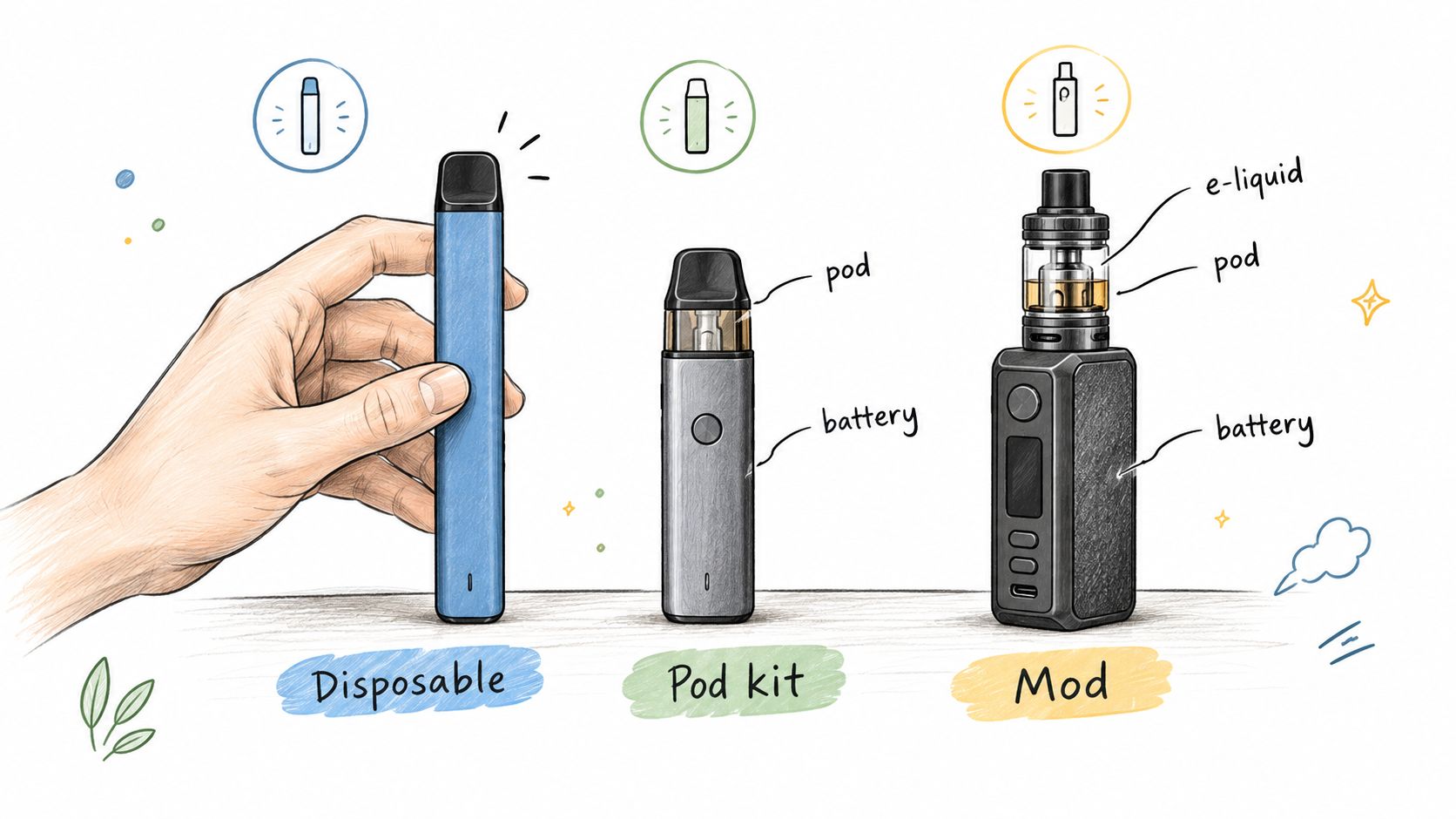
A customer walks in, picks up three nearly identical-looking devices, and asks which one is the “easy one.” That's the right question, because the outside often tells you very little. A pod vape gives you a rechargeable battery section and a pod section that carries the liquid, while a disposable tries to bundle everything into one throwaway unit and a mod usually adds more controls, more power, and more upkeep.
The middle ground that confuses shoppers
Pod systems became a major part of the U.S. vaping market after JUUL entered in 2015, and the public-health debate around them grew quickly when youth use rose sharply in 2017 and 2018, including a jump from approximately 2.1 million to 3.6 million U.S. middle- and high-school students who currently used e-cigarettes (CDC). That history matters because pod devices were compact, rechargeable, and built around replaceable nicotine cartridges, which made them easy to carry and easy to copy in later product styles.
Practical rule: if a device has a separate pod that holds the liquid, you're dealing with a pod system, not a true disposable.
That distinction matters at the register. The device shape can look familiar across categories, but the daily routine changes a lot. A pod kit may let you swap cartridges or refill a cartridge, while a disposable doesn't ask you to think about those steps at all.
Why the format keeps showing up
Pod vapes became popular because they felt less bulky than older vape setups and less limited than a single-use stick. For adult shoppers, that balance is often the reason they get chosen over a one-piece disposable or a more complex mod. The catch is that the same convenience can make marketing claims feel interchangeable when they aren't.
A pod label might sound simple, but the question is always the same, what does the device expect you to do next? If the answer is “swap a cartridge” or “fill a pod,” you're in pod-kit territory. If the answer is “use it until it's done,” you're looking at a disposable instead.
Closed Pods and Refillable Pods Explained
A lot of shoppers use “pod vape” as if it means one thing. It doesn't. The biggest practical split is between closed pods and refillable pods, and that choice changes how the device feels in daily use, how often you handle it, and how much flexibility you get with liquid selection.
Closed pods keep the routine simple
Closed pods come pre-filled. You use the pod, then replace it when it's empty. That setup suits people who want fewer steps, less mess, and a more predictable experience from one pod to the next.
Closed systems also make sense if you don't want to think about bottle tips, filling holes, or the possibility of spilling liquid in a bag. For many adult shoppers, that ease is the whole appeal. There's less to learn, and the pod usually arrives ready to slot in and use.
Refillable pods give you more control
Refillable pods are built for people who want to add their own e-liquid. The pod itself is reusable for a period of time, and you replace it when the coil or wick stops performing well. That gives you more control over liquid choice and can make sense if you already know what style of vape you prefer.
The tradeoff is routine care. Refillable systems ask for a little more attention to filling, sealing, and coil condition. That extra flexibility is useful, but it also means performance depends more on how carefully the pod is used.
Simple buying test: if you want the least hands-on option, start with closed pods. If you want more liquid control and don't mind regular upkeep, refillable pods make more sense.
What the choice changes day to day
The pod type affects more than convenience. It can change how much you think about airflow, how often you replace hardware, and how consistent the draw feels over time. If you're comparing starter kits, ask whether the system is designed around sealed cartridges or reusable pods, because that answer shapes the whole ownership experience.
How Pod Vape Systems Work
A pod system works best when the battery, coil, wick, airflow, and liquid all match each other. If one of those parts is off, the device can feel weak, harsh, or inconsistent even when the pod itself looks fine. That's why puff count alone never tells the whole story.
The parts that actually do the work
The battery sends power to the coil. The coil heats the liquid that the wick has pulled in, and the airflow controls how much vapor you feel on the draw. Nicotine concentration matters too, but it doesn't work by itself, because delivery depends on the whole setup, not just the label on the bottle or pod.
A controlled study of pod-mod, disposable, and box-mod devices found pod-mod power ranging from 4.1 to 21.7 W, with disposable devices averaging 8.4 W and pod mods averaging 9.3 W. The same study reported estimated nicotine flux across tested devices and liquids ranging from 12.0 to 160.1 micrograms per second (PMC). Those numbers show why two devices with similar-looking marketing can behave very differently in actual use.
Why similar puff counts can feel different
A puff count is a lab-style estimate, not a promise that every draw will feel the same. Draw length, battery condition, airflow, coil wear, and liquid formulation all change the result. A pod that feels smooth on day one can feel different once the coil starts aging or the battery is no longer holding charge the way it did at the start.
| Factor | Why It Matters |
|---|---|
| Coil resistance | Changes how much heat the pod can produce |
| Battery power | Affects how consistently the pod fires |
| Puff duration | Longer draws can change vapor and nicotine delivery |
| Airflow | Alters draw tightness and vapor feel |
| Liquid nicotine concentration | Works with the device, not by itself |
A good mental model is to think of the pod as a matched system, not a single number on a package. For a practical example of how product pages can present starter-kit details, the RAZ Vue 50K starter kit guide shows why shoppers should read the device and pod together instead of isolating one spec.
Pod Vapes vs Disposable Vapes and Mods
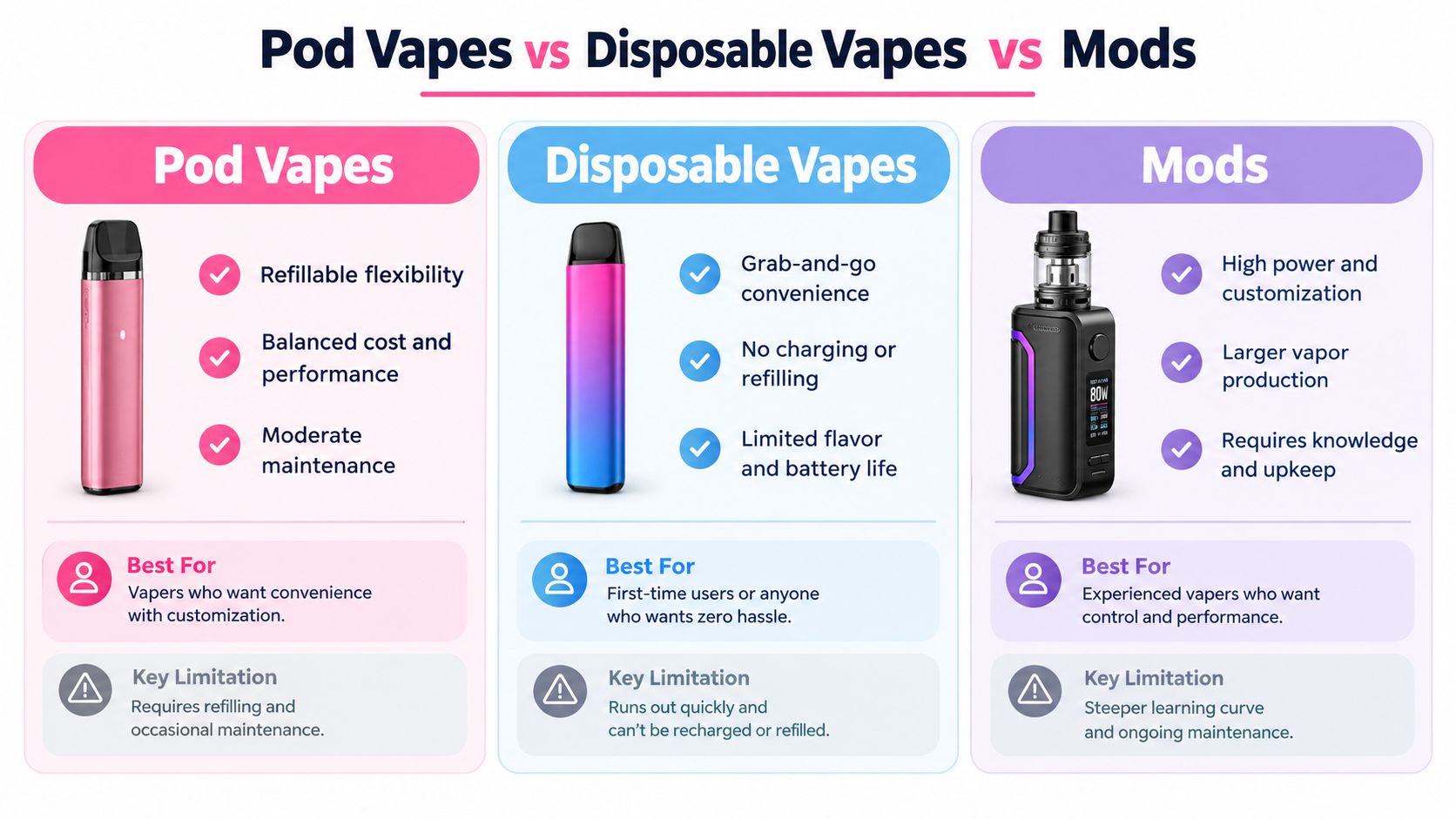
If you only care about convenience, a disposable can look like the easiest answer. If you want more control, a mod may look more appealing. A pod system lands between those two, and that middle position is why so many adult shoppers end up comparing all three side by side.
Other Popular Pod-Based Vape Systems and Replacement Pods
Pod-based vape systems come in different designs, and understanding these differences can help adult users identify which devices and replacement pods are compatible. Some systems use a rechargeable power unit with replaceable pods, while others feature magnetic connections or prefilled cartridges. To illustrate how these designs work in practice, let's look at three examples: the Geek Bar Mate 60K Kit, Geek Bar Mate Replacement Pods, and HQD SNAP 50K Pod Kit.
Geek Bar Mate 60K Pod Kit
The Geek Bar Mate Kit 60K is an example of a pod-based vape system that combines a reusable power component with compatible replaceable pods. Unlike traditional all-in-one disposable vapes, this design allows users to replace the pod rather than the entire device. Learn more about the Geek Bar Mate Kit 60K Puffs and its available options.
Geek Bar Mate Replacement Pods
Replacement pods are an important part of understanding how pod-based vapes work. Instead of replacing the entire device when a pod is depleted, users can install a compatible replacement pod while keeping the main power unit. The Geek Bar Mate Replacement Pod is designed for the Geek Bar Mate system, making compatibility an important detail to check before choosing a replacement.
HQD SNAP 50K Magnetic Pod Kit
The HQD SNAP 50K is another example of a pod-based system. It combines a rechargeable power bank with a magnetic disposable pod, allowing the pod to be replaced separately from the power component. The device also features USB-C charging and a display for monitoring device information. Explore the HQD SNAP 50K Pod Kit to understand how this magnetic pod system differs from conventional disposable vapes.
The tradeoffs are practical, not theoretical
Disposables win when someone wants the least amount of upkeep. They're simple to carry, simple to use, and simple to replace. Pod systems win when the shopper wants more flexibility than a throwaway device gives, but doesn't want the learning curve of a larger mod.
Mods still have a place for people who want power and customization, but they ask more from the user. They're usually bigger, more configurable, and more demanding in terms of maintenance. That extra capability matters to some buyers, but it's not automatically better for someone who just wants a clean, repeatable daily device.
Good comparison habit: don't ask which category is “best.” Ask which one fits the amount of effort you're actually willing to put in.
Why puff count and nicotine labels can mislead
In pod vapes, the same puff claim can hide very different experiences. A strong pod on an efficient device can feel far more intense than a weaker pod on a low-power device, and a high puff count doesn't guarantee that every draw will be useful or satisfying.
The market history backs up that caution. CDC data showed that prefilled pods were the dominant device type among U.S. youth in 2019 and 2020, while disposable use jumped from 2.4% to 26.5% among high-school users and from 3.0% to 15.2% among middle-school users (CDC). That shift shows how fast form factors can change, which is one reason shoppers should focus on the actual device format, not just the marketing language around it.
Pod Vapes, Disposable Vapes, and Mods Compared
| Option | Best For | Key Limitation |
|---|---|---|
| Pod Vapes | Adults who want a balance of convenience and flexibility | Needs compatible pods and some upkeep |
| Disposable Vapes | Shoppers who want the simplest possible setup | Little control and limited reuse |
| Mods | Users who want more power and customization | More learning and more maintenance |
For a broader shopping comparison, the replacement pods and disposable kits guide is useful reading because it separates device category from cartridge style in a way many product pages don't.
Pod Compatibility, Specs, and What Actually Matters
Compatibility sounds simple until you buy a pod that fits physically but doesn't behave the way you expected. The metal contacts line up, the pod clicks in, and the device still feels off. That's because fit and performance are not the same thing.
Why matching a pod isn't just matching the connector
Replacement and third-party pods can change how a device behaves. In one machine-puffing experiment using a JUUL battery, aftermarket pods drew more electrical power than the manufacturer pod, and aerosol and nicotine output reached up to three times the original product's output. A separate toxicology study found a third-party reservoir produced a maximum total-particulate-matter yield of 12.4 mg per puff versus 2.2 mg per puff for the manufacturer reservoir, with a maximum aerosol concentration more than seven times higher (AUB scholarworks).
That doesn't mean every replacement pod is bad. It means the device maker's compatibility guidance matters more than a quick visual match. Pod resistance, wick construction, electrical contacts, liquid formulation, and temperature behavior can all affect how the pod performs.
What to check before you buy
- Device pairing: Make sure the pod is made for your exact device generation, not just the same brand.
- Pod type: Confirm whether the kit uses a closed cartridge or a refillable pod.
- Coil and resistance details: Look for specs that tell you how the pod is supposed to fire.
- Liquid compatibility: Check whether the pod is designed for a specific formulation style.
- Manufacturer guidance: Follow the brand's compatibility notes instead of assuming “close enough” will work.
The FDA treats pod vapes as ENDS, and that category includes vapes, vape pens, e-cigarettes, e-hookahs, e-cigars, and e-pipes that deliver aerosolized liquid for inhalation (FDA). It also says authorization is product-specific, not a blanket approval for a whole brand or device family (FDA). That's why the exact pod, the exact device, and the exact pairing all matter.
Pod Compatibility and Spec Checklist
| Spec or Check | What to Look For |
|---|---|
| Device model | Exact generation, not just the brand name |
| Pod format | Closed pod or refillable pod |
| Coil match | Pod designed for the device's operating range |
| Liquid type | Intended formulation and nicotine style |
| Connection fit | Secure contact and proper alignment |
| Manufacturer support | Clear compatibility statement from the maker |
A product page can save you trouble by naming the device and pod together, which is why the Beri Cliq 50K replacement pods review is worth checking if you're comparing replacement-pod behavior rather than just looking at puff claims.
Maintenance, Troubleshooting, and Safety Basics
Most pod problems start small. A weak draw, a blinking light, or a strange taste often comes from a simple issue like a loose pod, a low battery, or a pod that's close to empty. The good news is that you usually don't need tools or technical knowledge to spot the basics.
The everyday checks that matter most
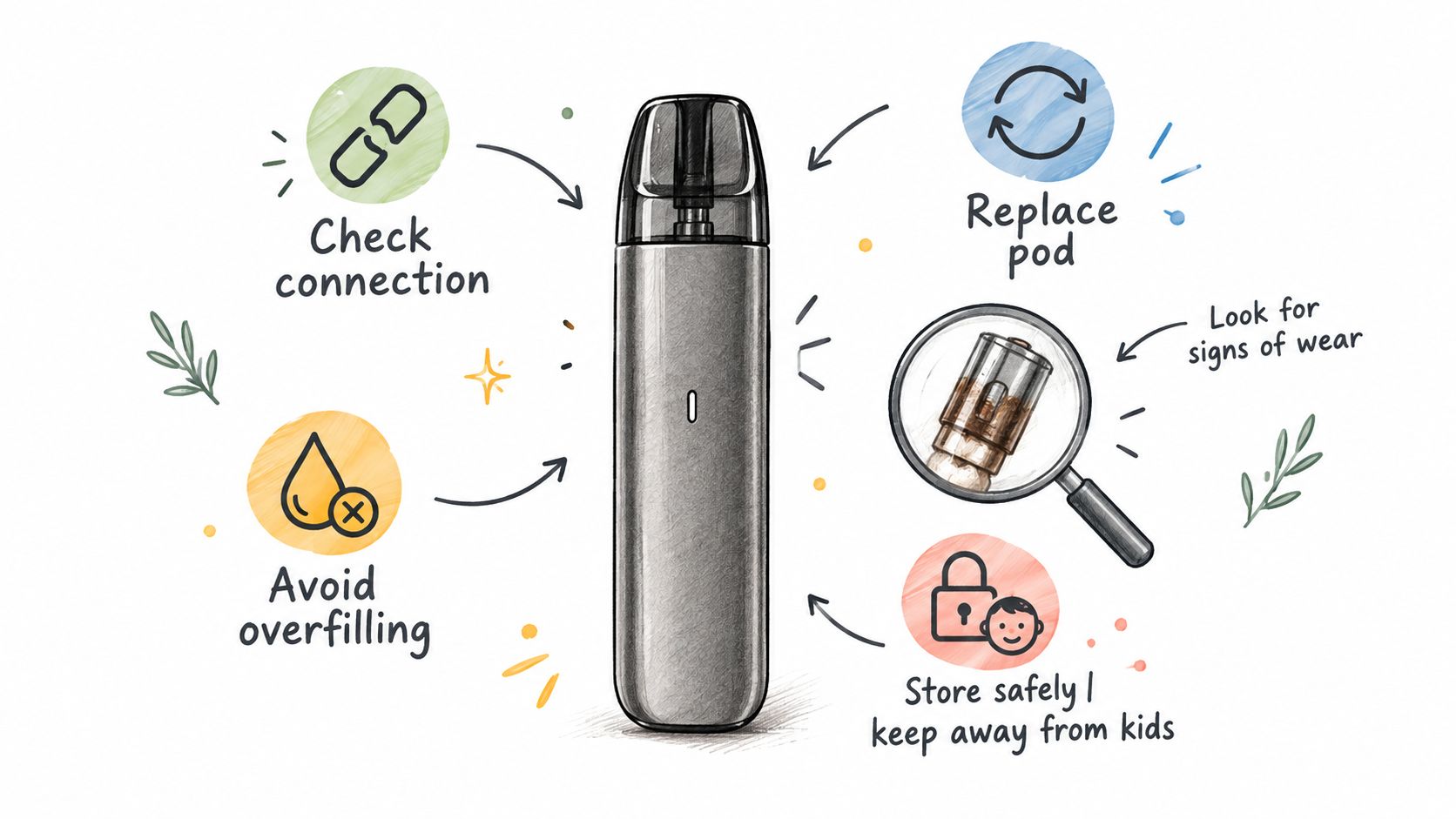
Start with the connection points. If the pod isn't seated properly, the device may not fire consistently. If you see condensation or liquid around the contacts, wipe them gently and let the unit dry before using it again.
A brand-new pod that tastes burnt too quickly usually wasn't primed long enough, while a gurgling pod can mean excess liquid is sitting where it shouldn't. If the pod is empty or the coil is spent, replacement is usually the cleanest fix. For practical troubleshooting habits, manufacturer support pages often point out the same patterns again and again.
Clean contacts, upright storage, and the right pod fit solve more problems than most people expect.
Keep the device in usable condition
Store pod devices away from children and pets, and follow the maker's instructions for charging and handling. Treat the pod like a consumable part when the taste drops off or the draw becomes unreliable, because pushing a failing pod often creates more frustration than it solves.
Legal status also belongs in the maintenance conversation. An HHS data sheet citing FDA and NielsenIQ information estimated that approximately 54% of e-cigarette devices and pods or cartridges sold in U.S. retail stores were illegal products as of July 2025 (HHS). That figure is one reason a pod should be checked for authorization details, tamper evidence, and packaging integrity, not just for how familiar the brand name looks.
What not to assume
A product can be genuine but still unauthorized for U.S. sale, and a counterfeit can imitate a legitimate brand. Those are different problems. Brand recognition alone doesn't prove that a pod is authorized, and a clean-looking package doesn't prove it's safe to trust without checking the details.
Buying Pod Vapes With Confidence
The easiest way to shop pod systems is to slow down for one minute and verify the parts that actually matter. Start with the exact device name, then confirm the pod is made for that device, then check the pod type, nicotine labeling, and any manufacturer compatibility notes. If the listing leaves those details vague, that's a reason to pause.
A simple checklist for product pages
- Confirm the device and pod pairing. Make sure the replacement pod or starter pod is built for the exact kit, not just a similar-looking one.
- Read the authorization language carefully. FDA authorization is product-specific, so one item from a brand doesn't automatically cover another.
- Check the package details. Look for clear manufacturer information, nicotine labeling, and tamper-evident packaging where available.
- Compare like with like. Don't judge two pod systems only by puff count or nicotine percentage.
- Separate legal from counterfeit concerns. A product may be unauthorized without being fake, and a fake product may look convincing at first glance.
That approach is especially useful because product availability, flavor lists, and inventory can change. A customer browsing adult retail sites should rely on the current product page, the current manufacturer guidance, and the current authorization status rather than memory or brand familiarity.
The decision that saves the most regret
If you want the simplest path, choose a pod system that clearly states the matching device and pod, then stay within that pairing. If you want more flexibility, check whether the system is refillable and whether the liquid style fits the pod's design. If you want the least uncertainty, don't buy a replacement pod until you've confirmed that the exact configuration is listed by the maker.
Pink Smoke Shop carries vaping products and replacement pods for adult customers, and the most useful way to shop them is with the compatibility details in hand. Visit Pink Smoke Shop to review current product pages, compare pod-system options, and verify the exact device and pod combination before you buy.
Frequently Asked Questions
Do all replacement pods fit the same device?
No. Pod fit depends on the exact device model and generation, not just the brand name. A pod that clicks into place can still behave differently if the resistance, contacts, or liquid design don't match the device.
Why do puff counts vary so much?
Puff counts are estimates, not guarantees. Draw length, battery condition, airflow, and pod wear all affect how many usable draws someone gets.
Can I switch flavors in any pod system?
Only if the system is built for that. Closed pods usually mean swapping sealed cartridges, while refillable pods let you change liquid more directly.
What should I check first on a product page?
Check the device name, pod type, and compatibility statement first. After that, look at nicotine labeling and any manufacturer notes about pairing.
If you want help narrowing down a pod setup, start with the exact device you own or plan to buy and compare the matching pod pages carefully. Pink Smoke Shop's current listings can help you check compatibility before checkout, and the product pages make it easier to verify what fits, what doesn't, and what's authorized for sale.