

Tobacco Free Vapor Explained: Ingredients and Buying Tips
You clicked a product page that says tobacco free vapor, and the label looked reassuring until you had to stop and ask a basic question. Does it mean no tobacco leaf, no nicotine, or just a different kind of vape? Adult shoppers run into that confusion all the time, because one phrase is doing the work of four separate ideas.
The clean way to read it is to split the label into tobacco-leaf content, nicotine source, nicotine strength, and what the device heats into aerosol. That sounds technical, but it's really just label literacy. Once you separate those four pieces, the product page gets a lot easier to read, and the marketing language gets a lot less slippery.
Table of Contents
- Why the Label Tobacco Free Vapor Raises So Many Questions
- What Tobacco Free Vapor Means
- Tobacco Free Versus Nicotine Free Versus Reduced Exposure
- How to Read a Disposable Vape Label Step by Step
- Choosing a Nicotine Strength That Matches Your Style
- Common Misconceptions About Tobacco Free Vaping
- Smart Buying Tips and Final Takeaways
Why the Label Tobacco Free Vapor Raises So Many Questions
A shopper lands on a page marked tobacco free vapor, sees a flavor name, maybe a nicotine percentage, and assumes the biggest question is already answered. Then comes the follow-up: if there's no tobacco, is there also no nicotine, and if there's no nicotine, why does the page still talk about a vapor device at all?
That confusion is normal, because the phrase sounds broader than it is. It usually tells you one thing only, that the product doesn't contain tobacco leaf. It does not automatically tell you whether the device contains nicotine, whether that nicotine is synthetic, or what ingredients are being heated.
Four questions hiding inside one label
A better habit is to ask four separate questions every time:
- Is there tobacco leaf in the product? That's the narrowest meaning of tobacco free.
- Is there nicotine at all? A product can be tobacco free and still contain nicotine.
- What is the nicotine percentage? A printed 0%, 3%, or 5% tells you more than the flavor name ever will.
- What is being heated? The aerosol comes from a liquid formulation and device design, not from the label alone.
That's why a tobacco free sticker can't do all the work. It answers one part of the story, then leaves the rest to the ingredient panel, the nicotine statement, and the device description. If you're comparing products online, that's the difference between reading the headline and reading the listing.
What Tobacco Free Vapor Means
At the simplest level, tobacco free vapor means the product is not built around tobacco leaf. That label points to the source material, not to every part of the device or every substance in the aerosol. Adult shoppers often read it as a promise of harmless mist, and that is more than the label is saying.
The aerosol is heated liquid, not water vapor
What comes out of these devices is an aerosol, not water vapor. The liquid typically uses propylene glycol, vegetable glycerin, flavoring compounds, and sometimes nicotine. The device heats that liquid, and the mix of ingredients, coil design, voltage, and puffing behavior all shape the output.
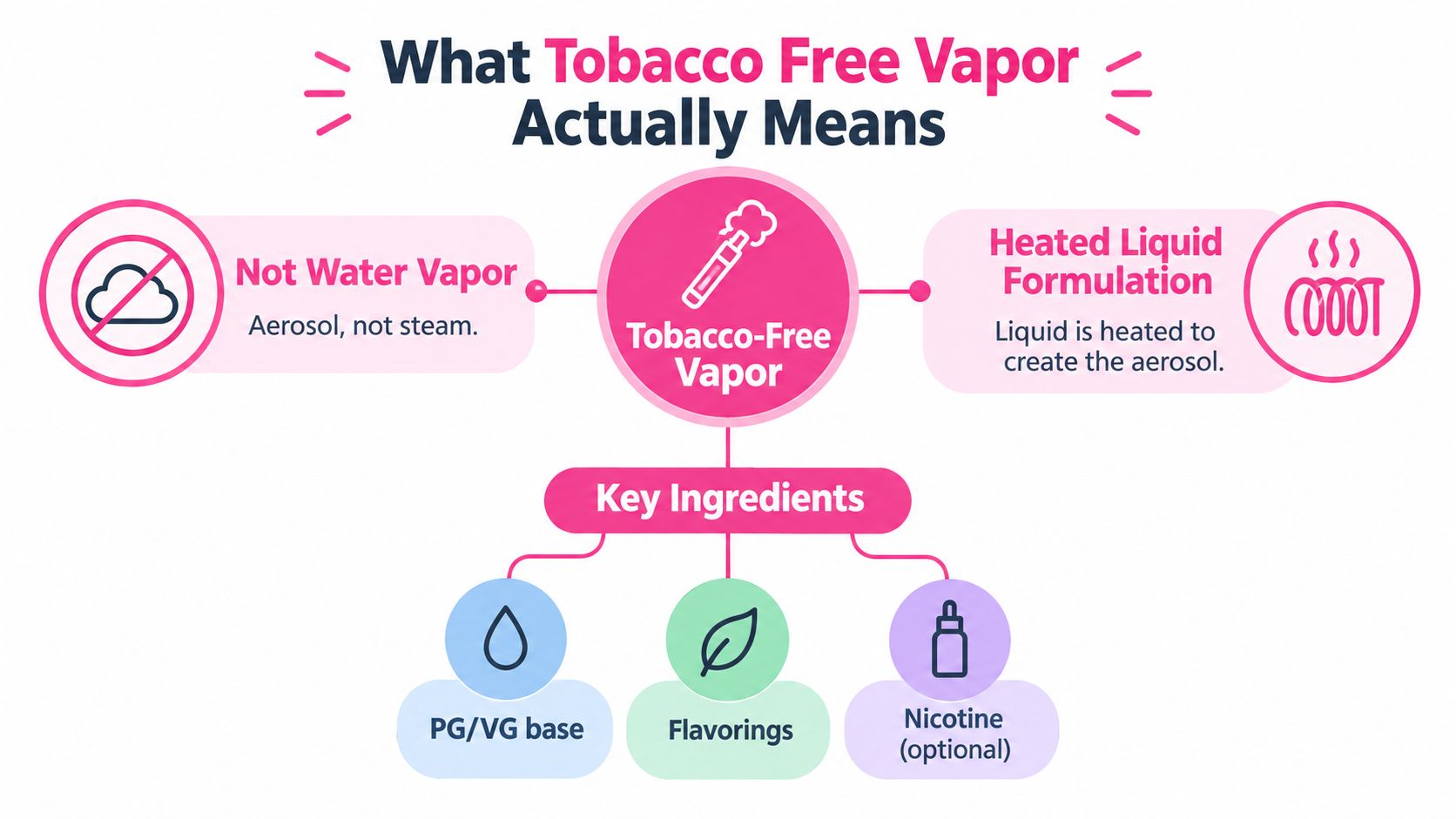
The output is closer to a heated mist from a liquid base than to steam from a kettle. The point is not that every device behaves the same. The point is that the label on the front panel does not tell you everything about what gets heated inside.
Practical rule: if the package says tobacco free, read that as a statement about tobacco leaf, not as a promise about aerosol chemistry.
Higher operating temperatures can change what forms in the aerosol, and a dry coil can change it again. That is why the device matters as much as the liquid. Two products can both say tobacco free and still behave differently once they are turned on.
Tobacco Free Versus Nicotine Free Versus Reduced Exposure
Shoppers often get tripped up because product pages mix labels that sound related but mean different things. A tobacco free product, a nicotine free product, a synthetic nicotine product, and a reduced exposure claim are not interchangeable. They answer different questions, and the wrong one can send you in the wrong direction.
| Label | What it actually means | Still present | What it does not cover |
|---|---|---|---|
| Tobacco free | No tobacco leaf | Flavorings, solvents, device components, and possibly nicotine | It does not tell you whether the product contains nicotine |
| Nicotine free or 0% nicotine | No nicotine in the formulation, as labeled | Aerosol ingredients and device materials | It does not mean the aerosol is just water, and it does not guarantee a nicotine-free supply chain |
| Synthetic nicotine | Nicotine made without tobacco leaf, but still regulated as a tobacco product in the United States | Nicotine, solvents, flavorings, device components | It does not mean outside federal tobacco-product rules |
| Reduced exposure | A claim about lowering certain exposures, not a promise of safety | Some exposure pathways still remain | It does not mean safe or harmless |
If you're looking at a tobacco free nicotine free vape, that phrase should mean the product claims both no tobacco leaf and no nicotine. If either part is missing, the wording is incomplete or inconsistent. For a deeper shop-level overview of non-nicotine options, see Pink Smoke Shop's guide to non-nicotine e-cigs.
The useful habit is to separate the label into its pieces instead of reading it as one slogan. Once you do that, “tobacco free” becomes a description, not a verdict.
How to Read a Disposable Vape Label Step by Step
A good label check starts before you click add to cart. The fastest way to avoid confusion is to read the product page in the same order a careful shop associate would: brand, flavor, nicotine, warning language, then the device details. That sequence works whether you're comparing a sealed disposable or a rechargeable model.
On a listing such as the HQD Cuvie Mars 8000, the useful details usually live in the product title, the flavor name, and the specs area, rather than buried in the marketing copy. The exact layout changes by page, but the habit stays the same.
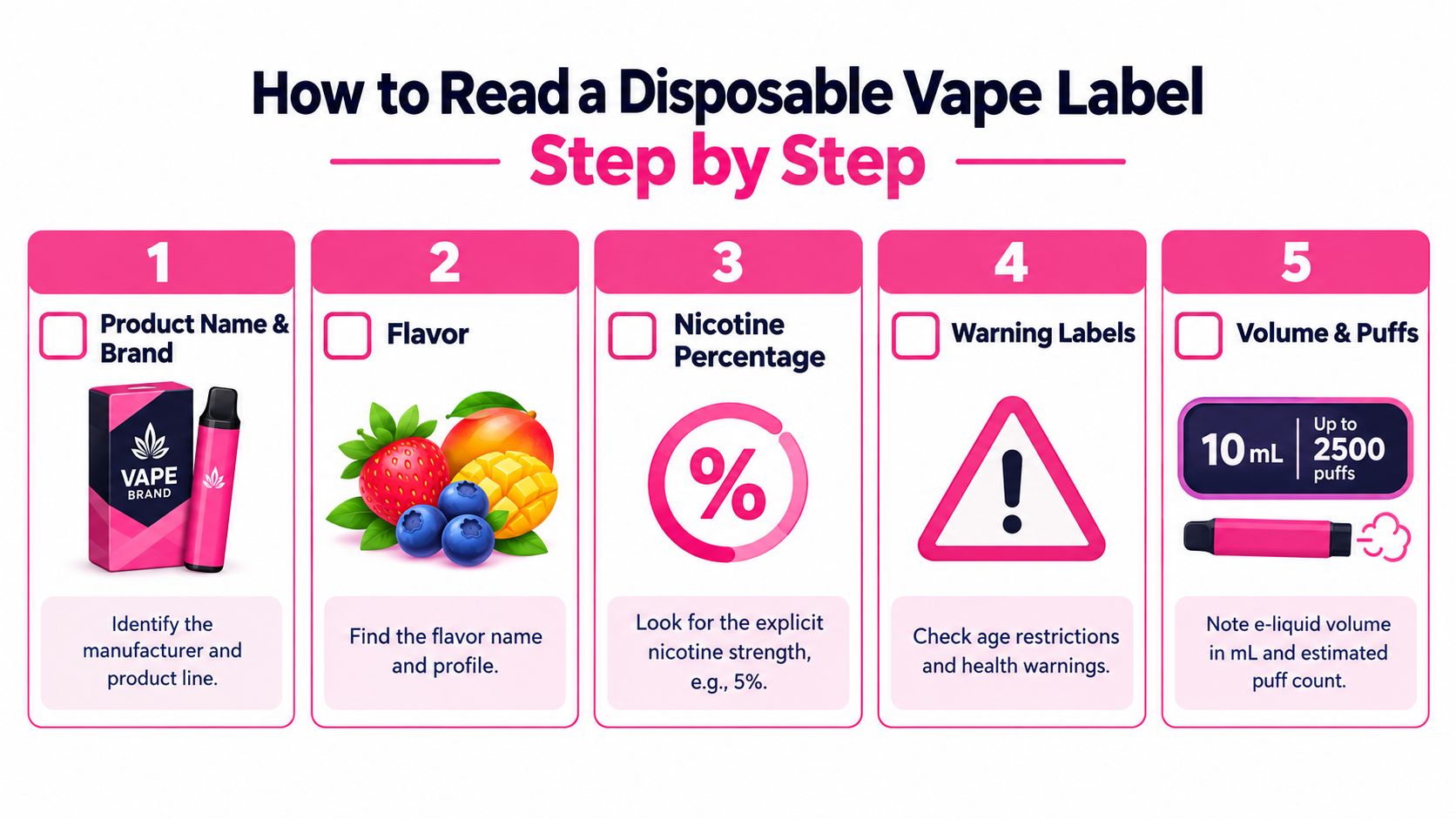
What to scan first
- Product name and brand: Confirm who made it and what line it belongs to.
- Flavor: Find the actual flavor wording, not just a decorative image.
- Nicotine percentage: Look for the printed strength, especially if you're comparing 0%, 3%, and 5%.
- Warning labels: Check age restrictions and any state-specific notices.
- Device details: Note whether it's rechargeable or sealed, and whether the listing mentions volume, puffs, or battery behavior.
A separate guide to device styles can help when you're deciding between formats, especially if you're comparing disposable kits and pod-based options. Pink Smoke Shop's disposable vape kit and replacement pod guide is useful for that split.
Read the nicotine line before you get attached to the flavor name. That one habit saves more confusion than any marketing badge on the package.
If a listing doesn't make the nicotine level obvious, treat that as a signal to slow down. A clean product page should make the strength easy to find, not hidden behind puff-count language.
Choosing a Nicotine Strength That Matches Your Style
A clean label still leaves one practical choice, the nicotine strength that fits how you want the product to feel. Adult shoppers usually compare 0%, 3%, and 5%, and each one signals a different experience.
Reading the percentage in context
0% nicotine suits adults who want the flavor and device output without nicotine in the formulation. 3% is the middle ground, lighter than stronger options but still present enough to notice. 5% is the stronger choice, often the one experienced adult users look for when they want a more pronounced nicotine presence.
The useful part is that the flavor can stay the same while the strength changes. That is why product families matter so much on a listing page. A line such as the HQD Cuvie Plus 2.0 9K can show the same flavor across more than one nicotine level, which means the percentage deserves the same attention as the flavor name.
Simple rule: choose the strength first, then pick the flavor. Reversing that order can leave you with the wrong version of the same product.
A product page should make that number easy to spot. If it is buried under puff-count language or decorative copy, slow down and read again.
Write the percentage down before you browse flavors. That keeps the decision tied to the part of the label that changes the experience.
Common Misconceptions About Tobacco Free Vaping
The biggest mistake is treating tobacco free like a synonym for harmless. It isn't. It only tells you that tobacco leaf isn't the ingredient story, and that leaves open the questions that matter most on a product page.
Another common error is assuming a tobacco free product sits outside U.S. tobacco rules. It doesn't, if it contains nicotine from any source. Federal rules also cover nicotine from any source, including synthetic nicotine, so source language doesn't automatically change regulation. And a 0% label is still a label, which means it should be checked, not trusted blindly.
Practical rule: if the package says “free,” verify what is free, what isn't, and whether the claim is backed by the actual ingredient line.
A quick verification habit helps:
- Check the manufacturer name instead of relying on flavor graphics.
- Look for nicotine percentage in plain text.
- Confirm batch or lot information when it's available.
- Read age-restriction language before checkout.
- Treat “tobacco free” and “nicotine free” as different claims.
That's the label-reading mindset that keeps the conversation honest. It doesn't promise certainty, but it does force the package to speak clearly.
Smart Buying Tips and Final Takeaways
Start with the four labels that tell you something. Tobacco free tells you there is no tobacco leaf in the mix. Nicotine free tells you the liquid has no nicotine. Synthetic nicotine is still a nicotine source, so it deserves the same careful reading as any other nicotine line. The aerosol itself depends on the liquid and the device, so the marketing phrase alone never gives the full picture.
A few simple habits make a listing easier to trust:
- Start with a known brand and retailer before you chase a flavor.
- Read the nicotine percentage first, then look at the flavor name.
- Check age verification and state rules before checkout.
- Be skeptical of puff counts that sound too good without a clear spec sheet.
- Treat “free” and “risk-free” as different claims.
If you are comparing device styles as well as labels, Pink Smoke Shop's blog on rechargeable disposable vapes is a useful place to sort out the format before you choose a strength. That makes the next decision easier to read, even if you still need to pay attention.
Choose between 0%, 3%, or 5% in a known device family like the HQD Cuvie Plus 2.0 lineup, then check the product page for current flavor availability and pricing instead of guessing from the title. If you want to compare labels with a clear eye, browse the current selection at Pink Smoke Shop and read the nicotine line and ingredient panel on every listing before you check out.